About Playbook
A simulation environment — not a lecture platform
Playbook is a gated, role-based entrepreneurship simulation. Students build a simulated business across 7 sequential stages and 27 modules, using 13 distinct interaction types. Built on the curriculum of The Ultimate Entrepreneurship Playbook for Teens, it turns business concepts into interactive decisions — students learn by doing, not by watching.
The real platform
What students actually see
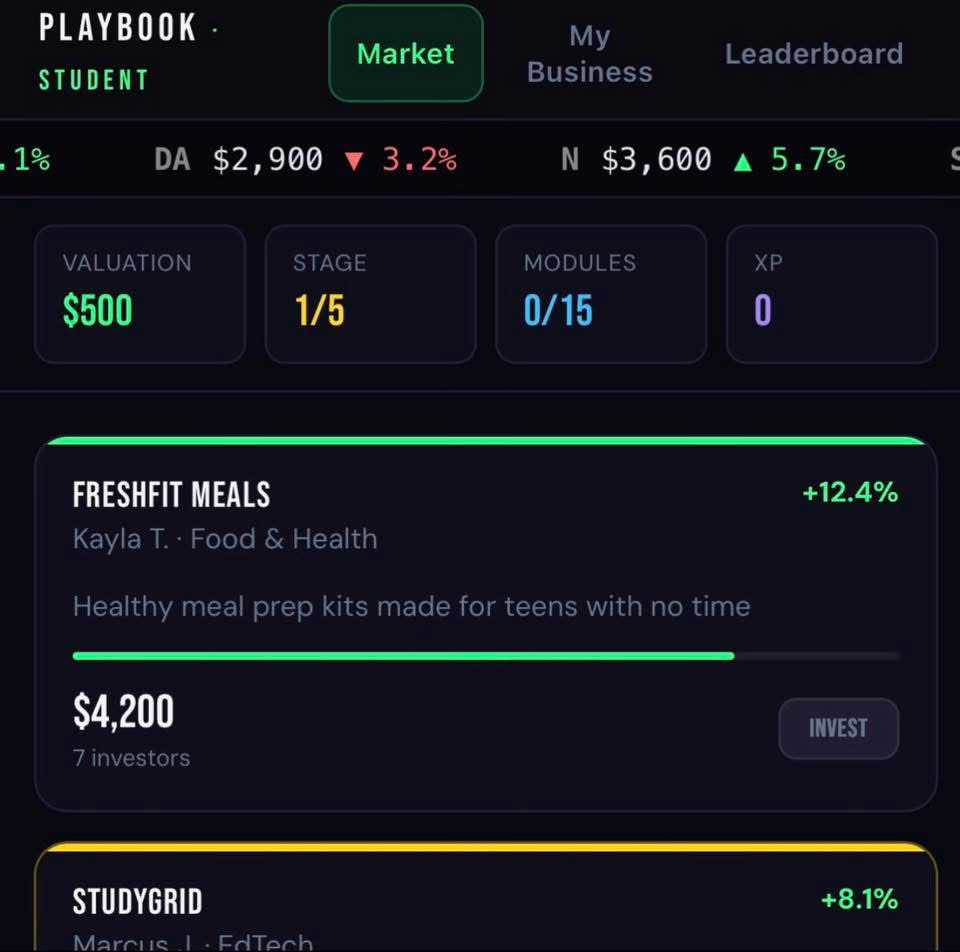
The Student view puts a business — with a live valuation, stage and module progress, and XP — at the center. From the Market, students browse and invest in their classmates' ventures, turning the whole class into a working economy.
- Live valuation that grows as the business develops
- Stage and module progress tracked at a glance
- XP earned by completing real simulation steps
- A peer market — students invest in each other
Origin
The book, the platform, the mission
Playbook began as a book — The Ultimate Entrepreneurship Playbook for Teens — written to teach young people to think and act like founders. The platform is that curriculum rebuilt as a simulation.
It sits at the intersection of CTE-aligned academics and applied entrepreneurship. The distinction shapes every product decision: students don't read about break-even, they compute it for a business they named. They don't memorize customer discovery, they run interview sims and defend their pricing.
Action over abstraction. Every module produces something a student can point to.
The simulation model
13 interaction types, working together
Each module is assembled from multiple steps of different types. A single module might open with a grade-adapted learn step, run a decision sim, then push the student into a live calculator and a canvas builder.
Learn
Grade-differentiated reading with clickable glossary terms — a different version for Junior High, High School, and College.
Sim
Chat-style decision scenarios with instant feedback. Pick an option, see whether you were right, learn from the result.
Quiz
Scored knowledge checks with personality-type outcomes, not just a grade.
Builder
Guided structured deliverables — a 30-second pitch, a first-10-users plan.
Canvas
Multi-section framework builders: Business Model Canvas, Brand Kit, Pitch Deck.
Deep Dive
Structured open-ended analysis — the who / frequency / cost breakdown of a problem.
Reflection
Journal-style prompts tied to the student's own venture idea.
Choice
Students pick from their own earlier answers to carry forward into the next step.
Calculator
Live Unit Economics Calculator — price, cost, and units become margin, revenue, and profit.
Break-Even
Live Break-Even Calculator with natural-language output: “Cookie 16 is profit.”
Research
Structured competitor analysis and market research exercises.
Competitor
Gap-analysis format for mapping the competitive field.
Tool
Standalone tool modules students return to throughout the simulation.
The seven stages
Stage-by-stage, with the modules inside each
Stages 1–6 are Semester 1. Stage 7 is the Semester 2 applied practicum. Progression is stage-based — students advance by completing and getting modules approved, not by clocking seat time.
Stage 1: Ideation
Find a real problem worth solving and shape it into a defensible idea.
- Spot the Problem
- Your Unfair Advantage
- The Big Idea Canvas
Stage 2: Validation
Test the idea against real customers before spending a dollar building it.
- Customer Interview Sim
- Competitor Radar
- Demand Proof Report
Stage 3: Business Model
Turn the idea into a model that actually makes money — priced and proven.
- Revenue Model Selector
- Unit Economics Calc
- Business Model Blueprint
Stage 4: Brand & Launch
Build the brand, the pitch, and the plan to put it in front of the world.
- Brand Identity Workshop
- Pitch Deck Creator
- Public Launch Strategy
Stage 5: Scale
Grow deliberately — systems, people, and a pitch investors take seriously.
- Scaling Playbook
- Hiring Framework
- Investor Pitch Sim
Stage 6: Founder Toolkit
The advanced operating toolkit real founders reach for after launch.
- Legal Formation Basics
- Financial Modeling Workshop
- Marketing Execution Plan
- Fundraising Mechanics
Stage 7: Launch & Operate
The applied practicum — run the business, keep customers, decide what's next.
- Customer Retention & Support
- Operations & Systems
- Iterate or Pivot
- Sustaining & Exiting
Financial tools · CTE alignment
Live calculators, not worksheets
The Unit Economics and Break-Even calculators are the strongest CTE-alignment anchors in the platform. They're live, tied to the student's own business, and produce plain-language output. Try them — these are the real modules.
Cookie 51 is profit.
Canvas builders
Frameworks students actually fill in
Multi-section canvases — Business Model Blueprint, Brand Kit, Pitch Deck — turn abstract frameworks into structured deliverables.
- Students waste money on snacks that crash their focus
- Protein study bites, sold at the campus store
- Dorm students, 17–22, exam weeks
- Recipe from a nutrition-major co-founder
- $3.50 / pack
- Bulk exam-week boxes
- Campus store
- Dorm group chats
- Ingredients $1.10/pack
- Packaging
Grade-level differentiation
The jh / hs / college content system
Learn steps carry three variants. The switcher lives in every module modal, so a mixed-level classroom runs the same simulation at each student's right depth.
Start with the problem, not the product
Founders fall in love with ideas; markets pay for solved problems. Frame the gap between how things are and how people wish they were. The sharper you define that gap, the easier every later decision — pricing, pitch, positioning — becomes.
A gap between how things are and how people wish they were.
CTE alignment
Built for Texas CTE
Playbook aligns to Texas CTE TEKS and qualifies for Texas CTE Allotment and Perkins V funding consideration. The financial tools, structured deliverables, and stage progression map cleanly onto CTE course expectations.
- 19 TAC §127.275
- 19 TAC §127.276
- 19 TAC §127.15
Semester structure
One semester, or a full CTE year
Stages 1–6 — the core simulation. Ideation through the Founder Toolkit.
Stage 7 practicum — students use the Project Templates to build, test, and present a real micro-business concept.
Want it for your students?
Playbook is launching for 2026–27. Join the waitlist for early access and a launch invite.